
By Lindsay Johnson – Media Director
Every spring, Google, Meta and other major media platforms announce a long list of new features. Marketers spend a few days dissecting each update before moving on to the next one. But this year, the updates felt different.
When you step back from the individual product launches, a clear pattern emerges. Nearly every major platform is investing in the same three areas:
- Influence. Helping brands persuade buyers earlier in their decision-making process.
- Automation. Optimizing even more aspects of campaign execution.
- Measurement. Improving metrics beyond simple clicks and conversions.
These companies aren’t independently arriving at the same roadmap. They’re responding to a widely recognized shift in customer behavior because, once again, the way people buy has fundamentally changed.
Saying farewell to the classic funnel.
You may be familiar with the traditional “sales funnel.” For years, this is how marketers have mapped out a typical buyer’s journey. Prospects became aware of your company, evaluated a handful of options, searched online for more information and eventually made a purchase. It was never quite that orderly in practice, but it reflected a world where search engines played a central role in how people gathered information.
As sophisticated search functionality has been integrated into more platforms, the buying process has evolved for buyers and brands alike.
A major shift in buyer behavior.
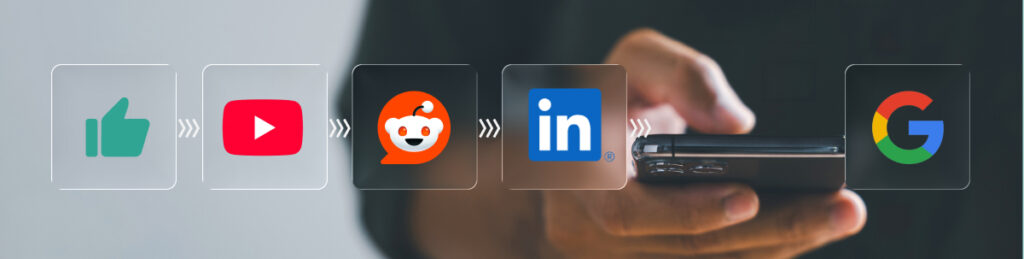
For example, a business leader researching a new insurance provider might hear a recommendation from a colleague, watch a YouTube video explaining a coverage issue, ask ChatGPT to compare providers, browse Reddit discussions, see a company’s thought leadership on LinkedIn and only then perform a branded Google search before requesting a quote. None of those interactions closes the sale, but each one builds confidence that they’re making the right decision.
That distinction matters because marketing’s job is increasingly about building confidence, not simply creating awareness. Buyers have more information available at their fingertips than ever before. They’ve gotten savvier and more discerning.
This spring’s platform announcements reinforce that shift in buyer behavior. Google continues expanding products like Demand Gen, YouTube integrations and creator partnerships – because buyers are forming opinions long before they search. Meta is investing heavily in AI-generated creative and measurement that looks beyond last-click attribution. Reddit is helping advertisers understand the conversations that influence purchasing decisions instead of simply targeting demographics. These platforms may be different, but they’re all reached the same conclusion.
The new way forward for search.
The truth is, buying has become a process of researching, validating and building trust across dozens of interactions.
That doesn’t mean search is becoming less important. In many industries, search remains one of the most effective ways to capture demand – and having a strong SEM strategy is still a key part of any media plan. What has changed is how much demand search is expected to create on its own.
When someone searches for your company after they’ve already seen your expertise, heard your name from a colleague or encountered your brand in several other places, search performs very differently than when it’s introducing you at the top of the traditional funnel. That’s why so many of Google’s recent investments focus on influencing buyers before they ever type a query.
For leadership teams, this new era of search has an important implication. Companies that invest only in capturing existing demand are becoming increasingly dependent on demand created somewhere else. Translation: Your marketing strategies need to capture demand and help create it by understanding the full scope of your buyer’s behavior and purchasing cues.
How AI is amplifying business objectives.
There’s another shift hiding in these announcements that deserves just as much attention. As more parts of campaign execution become automated, media platforms are asking marketers to contribute something different to get a stronger result.
Google’s AI Briefs don’t ask advertisers to spend more time selecting keywords. They ask them to define business objectives, brand priorities and the outcomes they’re trying to achieve. Meta continues reducing manual campaign controls while putting greater emphasis on creative quality and first-party data.
Across the industry, AI is taking over more of the operational work that once separated experienced practitioners from everyone else. While execution is becoming more standardized, your strategic approach is not. So, having a clear understanding of the connection between your marketing and your business objectives is more important than ever.
The best way to compete in today’s media landscape.
With this shift, a competitive advantage is coming from an entirely different place. A decade ago, the best marketers often won because they understood advertising platforms better than their competitors. They knew how to execute their campaigns really well. Today, those platforms are increasingly making the tactical decisions themselves. Moving forward, the organizations that outperform will be the ones with a sharper understanding of their customers, a clearer point of view and stronger creative that gives AI something worth amplifying.
Technology is making execution easier and making strategy more valuable. This isn’t just a marketing conversation. It’s a leadership conversation about where your business is headed.
Executive teams need to be having these conversations:
- If your customers are building confidence across multiple channels before they ever contact your company, does your marketing investment reflect that reality?
- If every competitor has access to the same AI-powered advertising tools, where does your competitive advantage come from?
- If the largest media platforms are measuring success in terms of business outcomes instead of platform metrics, are your internal conversations still focused on impressions, clicks and cost per lead?
What’s next for media strategy.
The individual features announced this year will continue to evolve, and some will inevitably disappear. The broader direction, however, is becoming increasingly difficult to ignore. Buyers are researching differently, media platforms are adapting accordingly and the organizations that grow over the next decade will be the ones that recognize those changes before their competitors do.