
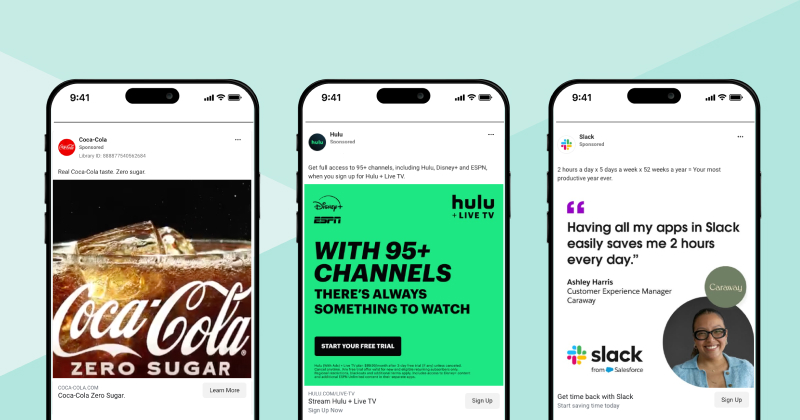
By Katie Herzog – Chief Client Officer
Marketing is often spoken about as if it’s a single discipline — a sort of business communications cure-all you can apply when growth stalls, sales soften or the story starts to feel fuzzy. “We need marketing” becomes shorthand for something isn’t working, with the assumption that the right agency, the right campaign or the right channel will sort it out.
That’s where we see a lot of well-intentioned companies get themselves into trouble.
“Marketing” isn’t one thing, and neither are marketing agencies. The world of marketing offers a vast menu of possible approaches, each designed to solve very different problems and requiring a unique set of skills to implement them. Organizations often end up hiring specialist agencies who are excellent at one kind of marketing (brand, performance or product) only to discover that their signature move doesn’t actually address the business challenge at hand.
It’s not that the agency is bad.
It’s that the strategy is mismatched.
And it’s where a marketing consultancy can help.
Before selecting an agency or a strategy – and potentially wasting budgets and patience – organizations should dig into the issue beneath the request. Is the problem about building awareness or trust? Defining your offering or converting customers? Product understanding or driving demand? Those answers will point you toward how you market and which kind of marketing should lead.
To make that choice, you first need to understand what each discipline is truly built to do, where it came from and how it serves a business when applied in the right context.
Brand marketing.
Meaning, memory and the courage to play the long game.
At its core, brand marketing is the discipline of meaning. It is less concerned with what happens today and more invested in what people remember tomorrow. Brand marketing answers the most existential question a business can ask: Why should anyone care about us at all?

Historically, brand marketing grew up in a world of mass media, where distribution was expensive and attention was finite. When companies invested in television, radio, print or billboards, they were making a bet — that repeated exposure, emotional resonance and consistency would compound over time. And it did. Iconic brands like Nike, Apple, Coca-Cola and Patagonia don’t just sell products; they sell belief systems. They make people feel something by anchoring themselves in aspiration, identity or shared values. That’s how they earn a place in people’s mental shortcuts.
In practice, brand marketing is one of the most challenging strategies to sell internally because it asks a business to commit to some very hard things:
- To stand for something long enough that it becomes recognizable.
- To make choices that won’t always optimize for immediate return but will build trust, familiarity and preference over time.
- To allocate leadership time and resources to building a brand vision that is clear about who you are and who you are not.
Brand marketing shines in creating demand before demand is measured. It lowers friction, gives product launches a running start and allows customers to choose you with less deliberation (because the decision already feels safe).
When a brand becomes untethered from reality, however, it creates friction. This can look like grandiose storytelling outpacing real experience, or values being polished but not actually practiced. When organizations invest heavily in brand before they have product-market fit, operational readiness or a clear path to growth, the result can hurt trust, rather than build it.
In those moments, brand can feel like theater — beautiful, expensive and oddly disconnected from results. And thanks to the accessibility of social media, consumers today are perfectly comfortable making noise about those disconnects.
Performance marketing.
Proof, precision and the discipline of reality.
If brand marketing is about belief, performance marketing is about proof.
Performance marketing serves a business by translating intention into measurable action. It thrives on clarity — clear audiences, clear offers and clear metrics. It answers the practical, sometimes uncomfortable question: Is anyone actually willing to do something because of this?

Its rise parallels the digitization of commerce. As search, social and programmatic advertising have matured, marketing has moved closer to finance. ROI can be tracked. Experiments can be run quickly with a test-and-learn approach. Growth can be engineered with increasing sophistication. Companies like Amazon, HubSpot and countless direct-to-consumer brands have built engines that learn, optimize and scale relentlessly.
Performance marketing is the harsh truth that protects marketers from self-deception. Often, it reminds businesses that good intentions and clever ideas are not enough. The market doesn’t grade effort— it responds to precision and relevance. Performance marketing forces specificity. It rewards clarity. It exposes weak assumptions quickly.
When used well, it is a powerful growth lever. Performance marketing helps organizations understand what messages resonate, which audiences convert and where investment pays off by creating feedback loops that make marketing smarter over time.
For all of its strengths, the danger comes when performance marketing is asked to carry the entire load. Without brand equity (that comes from brand marketing), costs rise and returns diminish. Without clearly defined positioning in the market, optimization accelerates the wrong message. Organizations find themselves chasing efficiency while eroding trust, squeezing short-term gains from a system that grows more brittle by the quarter.
When used in a vacuum, performance marketing without brand eventually becomes a tax on growth.
Product marketing.
Coherence, translation and shared understanding.
Product marketing often gets less airtime in these debates, but it may be the most quietly influential of the three.
Product marketing serves a business by creating coherence; literally marketing the features and benefits of specific products. It lives at the intersection of what a company makes and how the market understands it. As products, especially in technology and SaaS, became more complex, someone had to translate features into value and value into language that aligned teams and customers alike.
The best examples of product marketing don’t just explain functionality. Slack didn’t sell messaging software; it sold fewer emails and better teamwork. Notion didn’t sell a tool; it sold flexibility and personal systems. Salesforce didn’t sell CRM software; it sold customer success. In each case, product marketing clarified who the product was for, why it mattered and how it fit into a customer’s world.

At its best, product marketing is the ultimate expression of empathy. It requires a business to see itself from the outside, to confront confusion honestly and to make deliberate choices about focus. This type of marketing is all about asking hard questions: What problem are we truly solving for our customers? Who feels that problem most acutely? What do we lead with — and what do we let go?
Product marketing goes wrong when it is treated as a launch checklist instead of a strategic function. Instead, you want your product marketing to be formative, rather than reactive. These ads can’t compensate for a product that isn’t ready to deliver on its promise.
How brand marketing, performance marketing and product marketing work together.
When these three disciplines are aligned, they form a strategic system rather than a collection of tactics.
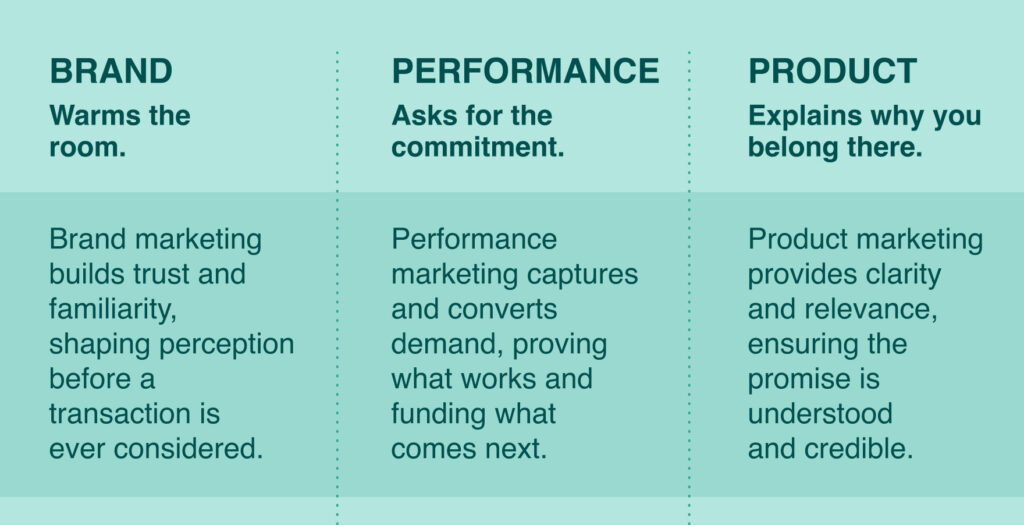
Each discipline strengthens the others. Brand makes performance more efficient. Performance provides feedback that sharpens product positioning. Product marketing gives brand and performance something solid to stand on.
The real risk: Choosing the right discipline at the wrong time.
Most marketing failures aren’t about poor execution. They’re about mistimed emphasis:
- Early-stage companies often invest heavily in brand before they’ve earned belief, mistaking visibility for traction.
- Growth-stage organizations squeeze performance harder when results flatten, instead of rebuilding trust and differentiation.
- Established companies launch new products without the positioning work required to support adoption, assuming demand will materialize on its own.
It’s like training for a marathon by only sprinting. Or, cooking a beautiful meal and serving it on paper plates with plastic forks. The effort is real…the outcome disappoints.
Marketing maturity isn’t about doing everything at once. It’s about knowing what the business needs now — and what it needs to start building quietly for later.
Where a marketing consultant actually helps.
A good consultant doesn’t pick sides. They read the room.
They look beyond channels and tactics to understand:
- Business goals, not just marketing KPIs.
- Market maturity and competitive pressure.
- Organizational alignment and capability.
- What’s broken — and what’s simply loud.
Then they help leaders sequence the work:
- What deserves investment now.
- What needs to pause.
- What must be built so the next phase of growth is easier, not harder.
The best consultants act less like megaphones and more like translators — helping organizations see where their instincts are right, where they’re premature and where they’re avoiding harder questions. They help teams reframe the challenge from “We need marketing” to “What does our business actually need at this moment to move forward with confidence?”
Because effective marketing isn’t about allegiance to brand, performance or product marketing. It’s about proportion, timing and leadership.
Do the right work.
In the right order.
For the right reasons.
That’s the difference between activity and progress — and between marketing that makes noise and marketing that actually moves your business.